
Author: Sharon Nagel, journalist
Ronald Khoo, Wine, Spirits & Beverages manager for the Hong Kong-based carrier Cathay Pacific, explains how altitude, taste and brand strategy shape one of the world’s most sophisticated airline wine programmes.
Credit: ©Cathay Pacific
In 2025, Hong Kong-based Cathay Pacific carried more than 28 million air passengers and was recognised by Skytrax as one of the world’s top three airlines. As a premium carrier – celebrating its 80th anniversary this year – Cathay Pacific’s wine programme is a direct extension of brand identity.
“We’re about quiet luxury; we’re elegant, not bling. We’re thoughtful but at the same time progressive,” says the airline’s Wine, Spirits & Beverages Manager Ronald Khoo, who moved into fine wine after a career in accounting. A former importer and retailer, Khoo brings a rare dual perspective on on-trade dynamics and the constraints at 35,000 feet.
At altitude, the wine list sits at the crossroads of sensory science, operational discipline and brand strategy – a complexity often underestimated by producers targeting the channel. In the low-humidity, high-noise cabin environment, passengers can lose up to a third of their olfactory sensitivity. Bitterness is amplified, while nuance is muted.
“Lower cabin pressure, reduced humidity and the hum of the engine at 80-85 decibels all affect how we taste – particularly humidity, which suppresses the nose. And 80% of perception comes from smell,” Khoo explains. “We look for wines that are more fruit-forward, with balanced oak, to overcompensate for the reduced ability to smell,” he says. “I look for balanced wines that flow – like an orchestra where everybody’s playing the correct tune.”
First-class performers
Credit: ©Cathay Pacific
Styles that consistently perform at altitude include Beaujolais, Shiraz, Sauvignon Blanc and fruit-driven Chardonnay. By contrast, more delicate, nuanced styles can disappoint. “Some neutral Italian grape varieties, for instance, become difficult to perceive in the air,” Khoo notes. Execution is just as critical as selection. Airline buyers deploy a range of levers to compensate for these constraints, from wine style to serving temperature and stemware.
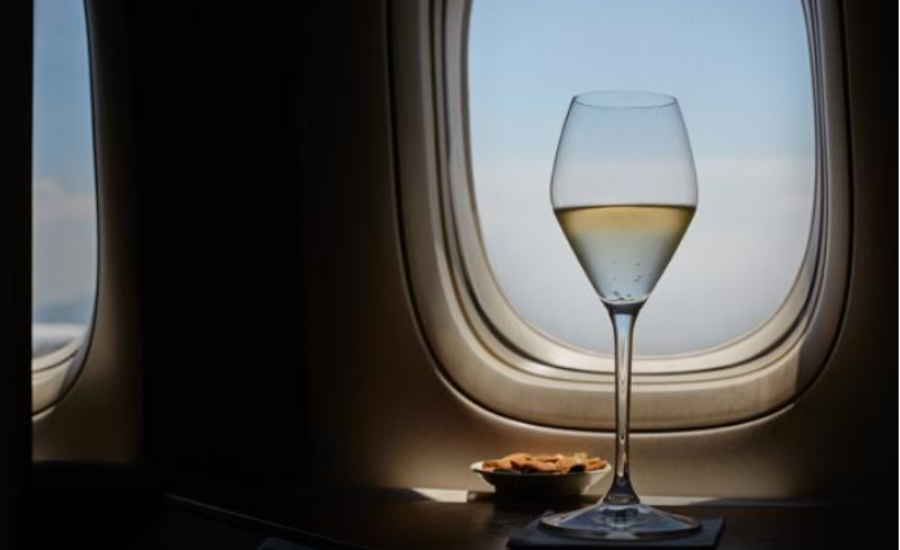
In first class, Cathay Pacific serves wines in Riedel stemware, favouring tulip-shaped glasses over flutes for Champagne to concentrate aromatics at the rim. Temperature control remains less precise, fluctuating with the seasons, so Khoo advises cabin crew to slightly over-chill wines so they become more expressive as they warm.
Before any wine reaches 35,000 feet, it has to pass muster with Cathay Pacific’s four-strong buying team, whose remit extends beyond wine to the entire dry goods portfolio. The team also sources for the airline’s five Hong Kong lounges and reviews selections across its lounges worldwide. Final decisions rest with a dedicated panel of three, including Asia’s first Master of Wine, Debra Meiburg.
The panel convenes three to four times a year, “to capture opportunities from both hemispheres, in the right vintage,” Khoo explains. Each blind tasting assesses around 300 pre-selected wines, narrowed down to meet specific category requirements. Just 5-7% make the final cut, typically through consensus following individual evaluation. Tasted blind, wines are judged independently of third-party validation. “When we unveil the wines and see medals or scores, it’s nice that they have ratings. But generally, they don’t influence our decisions at the tasting stage.”
Overcoming operational constraints
Cathay Pacific operates a dual-sourcing model at the pre-selection phase, combining tenders with strategic partnerships. “Sometimes we have direct conversations with long-term partners when a wine aligns with a specific theme or moment,” Khoo says, citing a four-decade collaboration with Champagne Krug alongside enduring relationships with leading Bordeaux chateaux. Most wines, however, are sourced through formal tenders, now managed operationally by the travel retail arm of the Lynch-Bages group in Bordeaux. Lead times run to around eight months, but Cathay Pacific retains control over logistics.
Centralising logistics makes the process more manageable and allows suppliers to focus on getting the product ready and on time. “Delays impact us greatly. The last thing we want is to have no wine on board,” Khoo says, adding that because on board is at a premium, every case must justify its place. “It’s not like a restaurant where you can have a Bible. Here, you have to condense each list into six or seven wines, while ensuring the passenger experience remains exceptional.”
Across its global network, Cathay Pacific offers around 50 wines in-flight, supplemented by a further 30 in its lounges for premium passengers. “Overlap between the two is minimal. When a customer moves from the lounge to the aircraft, we want to offer variety,” Khoo says. Around half of the in-flight range rotates every quarter. High-volume SKUs on the global routes tend to stay in place longer, while more niche selections turn over more frequently. The portfolio, around 60% Old World, is partially decentralised. “We maintain the core classics – Champagne, Bordeaux and Burgundy – but when we fly to a wine region, we aim to honour that region with at least one local reference.”
A testing ground
Cultural resonance is another key driver, and one that passengers feel strongly about. “Some can be quite nationalistic,” Khoo says. “They’re proud of the wines from their region, so it makes sense to reflect that on the list.” Cathay Pacific is likely the only premium airline to offer an extensive range of high-end Chinese wines, having featured more than 30 labels over the past 18 months, including flagships Ao Yun and Long Dai. These were launched through Cathy’s Discovery Series, a curated, small-batch programme designed to engage wine enthusiasts while giving Khoo greater creative latitude.
“It gives the sommelier in me the freedom to build programmes without the constraints of the core list. The aim is to celebrate the joy of discovery,” he says. Themes range from women in wine and lesser-known grape varieties to rosés for summer drinking and volcanic island wines, turning the series into a real-life laboratory for trialling new range entrants.
“It’s a good way of gauging passenger response and understanding their affinity with different profiles,” Khoo notes. For suppliers, it also provides a more accessible entry point. Minimum volumes start from just a few hundred bottles, compared with the significantly larger allocations required for the core programme, where consistency across global routes limits mid-cycle vintage changes.
Another key lever is sustainability, which aligns with both technical operational constraints and corporate positioning. Lightweight bottles are not yet mandatory. 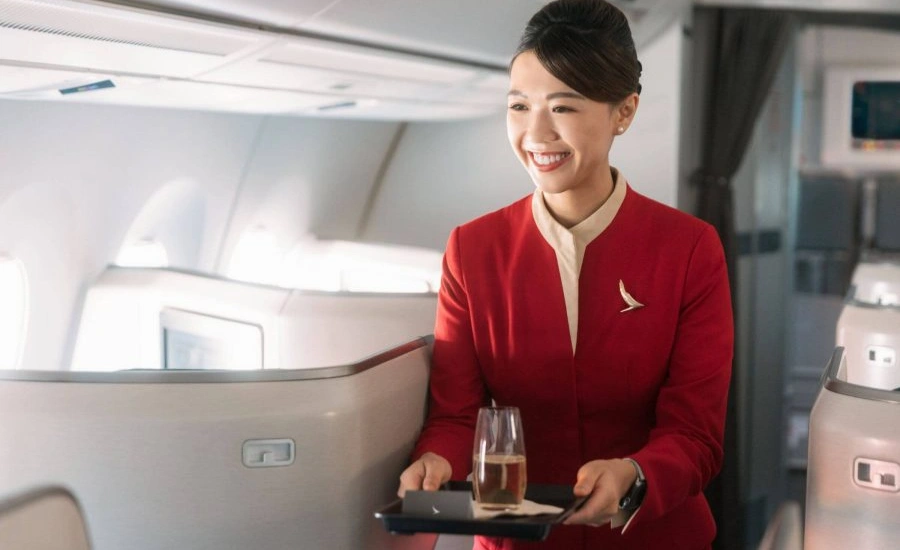
Credit: ©Cathay Pacific
“As you move up the value chain, wines tend to come in heavier, more luxurious formats, and we are respectful of that.” But Cathay Pacific is actively building metrics ahead of future tenders. “Sustainability is a core KPI across the business – from sustainable fuel to optimising weight on board.” Producers with B Corp certification, strong environmental credentials or regenerative practices benefit in the selection process. Looking ahead, the airline plans to more precisely factor in the impact of bottle weight on fuel consumption and the associated savings. PET formats, a familiar sight in Economy cabins elsewhere, are being evaluated and considered by Cathay Pacific.
“We haven’t found a solution that suits us yet,” Khoo admits. “The weight advantage is clear, but we need to strike a balance: Wine is part of our DNA, and our customers have to feel comfortable with what we present.” Screwcaps remain standard in economy class to enhance service efficiency.
Quality
Service quality is equally central to Cathay Pacific’s proposition, exemplified by the wine ambassador programme developed by Khoo. “They’re effectively flying sommeliers, my eyes and ears on board,” he says, explaining the impetus behind the initiative: “Customers told us the wines were not always served in the way they deserved. The obvious solution was education.”
Around 150 to 160 ambassadors have been trained to date, and the ambition is to eventually place at least one on every flight. The programme is expected to launch in the second quarter, initially on key routes before a wider rollout. The rationale is clear: Passenger feedback remains a core KPI in evaluating wine performance. “On a flight, there are only two things you do: watch the entertainment, and enjoy the food and wine. Maybe 7 out of 10 passengers will discuss the wines. So if it matters to them, it matters to us,” Khoo says.
In an increasingly AI-driven world, Cathay Pacific’s approach remains highly structured yet refreshingly human-led. This philosophy extends to the wines themselves. What makes a proposal stand out? “A well-made wine with a compelling and genuine story of provenance that aligns with our brand ethos and that we can share with our passengers. We want depth, not just brands driven by money,” Khoo says, pointing to Lynch-Bages as emblematic of that approach. “It started as a very genuine relationship – almost innocently – and we grew the brand together. That’s the kind of story money can’t buy.”
Beyond ultra-premium Bordeaux chateaux, which remain important to passengers, Khoo keeps an open mind, but insists that producers do their homework first. “It’s easy to view an airline’s wine list on the internet and then tailor a proposal to suit the company’s core focus. When suppliers present their entire portfolio, it makes it very difficult for me to filter and make a discerning choice,” he says, adding that “some small producers think they’re not ready to supply an airline, yet they have something compelling. Sometimes, it works.”
About Sharon Nagel

British-born Sharon Nagel has been a journalist and translator specialising in wine for 35 years. She writes for leading French online publication Vitisphere and also contributes to corporate communications.