
Author: Sharon Nagel
As the global wine industry grapples with the urgency of climate action and social responsibility, one message is clear: sustainability must be more than a label.
“With sustainability, initially you make fast inroads – it’s the low-hanging fruit – but then you bump up against complexity very quickly. You also face traRecent research by the Wine Market Council in the United States highlights a key obstacle on the wine industry’s path to sustainability: a lack of clarity and shared understanding, which hinders effective communication.
Consumers cited the absence of artificial ingredients and clear labelling of natural ones as top priorities, revealing just how nebulous the concept of “eco-friendly wine” remains. But what kind of information truly resonates and where is the line between honest messaging and overstatement? As visionary California winemaker Jesse Katz puts it, “The difference between serious land stewardship and greenwashing lies in transparency, depth of practice and long-term ecological thinking.”
The elephants in the room
Dr Peter Stanbury, research director with the UK-based Sustainable Wine Roundtable (SWR), feels that “there’s an awful lot of hot air in sustainability with many relying on half-truths.” With over 40 wine-specific sustainability schemes operating globally, the industry is fragmented and confusion can arise — not always with negative intent.
To promote clarity and “communicate a clear and unified vision of what sustainability truly means for wine,” the SWR has launched a standards benchmarking process. The Pilot Report featuring seven standards was published in December 2024 and the 30 or so others are due to follow this year.
Meanwhile, alcohol monopolies in Canada and Scandinavia are deepening their scrutiny of sustainability standards worldwide and galvanising their suppliers into action. Stanbury notes that while most standards offer strong guidance on vineyard practices, they tend to fall short in two key areas: post-winery operations and human rights.
“In the wine industry, we’re happy to talk about farming practices, bottle weights and other issues, but there’s still reluctance to address the workers’ side,” says Dom de Ville, director of Sustainability & Social Impact with The Wine Society (TWS) in the UK. “It’s almost like they’re worried about opening Pandora’s Box.”
As a member-owned business with a 150-year history, the company sees itself as a long-term “custodian” looking as far ahead as it does behind. “Sustainability just makes good business sense. It brings a lot of financial efficiencies and ticks every box,” argues de Ville, who has spent a career in sustainability. Yet he notes several pitfalls, such as creating “wonderful plans” but failing to resource a team to deliver them, or allowing these strategies to fall by the wayside when the going gets tough.
de-offs – rail over road for instance – and have to deal with very real world commercial issues,” de Ville says. “For example, we live in a demand culture and our customers appreciate free delivery on all orders, but that’s not great for carbon emissions.”
TWS relies on certifications — “We don’t have the resources to inspect all our own suppliers” — but de Ville says that “not all certifications are created equal.” By 2030, the company aims to use the SWR benchmarking report and to have 70% of the wines it buys come from producers with a credible sustainability certification. It will be mindful not to exclude the smaller players, who just “haven’t got the time or money to get the stamp,” de Ville says, noting that smaller producers often do things much more sustainably than the big ones.
Ahead of the curve
Charlotte de Sousa, who handles exports and communications at the namesake Champagne winery, couldn’t agree more, though she does have the rubber stamps: Champagne De Sousa has been certified organic for more than a decade and is now also certified biodynamic. Beyond the myriad certification requirements, the family winery has introduced agro-forestry, draught horses and even quartz in the winery, “for the feng shui effect,” out of personal conviction.
The family prides itself on taking the organic route well before it gained mainstream appeal: “When our father switched to organic, it was so frowned upon that he almost had to hide it,” de Sousa remembers. Today, the landscape has shifted and many of the large Champagne houses are jumping on board, some driven by ethics – “like Roederer” – others more by marketing considerations.
For de Sousa’s father, the aim was to achieve “precision and freshness in his wines. He thought that farming organically and biodynamically could help him achieve that.” Certification came later, at the behest of customers “seeking reassurance.” It took years to achieve over the 16 hectares of farmed vineyards: “farming organically and biodynamically over such a large and fragmented area is much more challenging than for the garage wineries, particularly in Champagne due to the weather,” says de Sousa, who spends time explaining vineyard and winery practices to customers, alongside her brother Valentin and sister Julie.
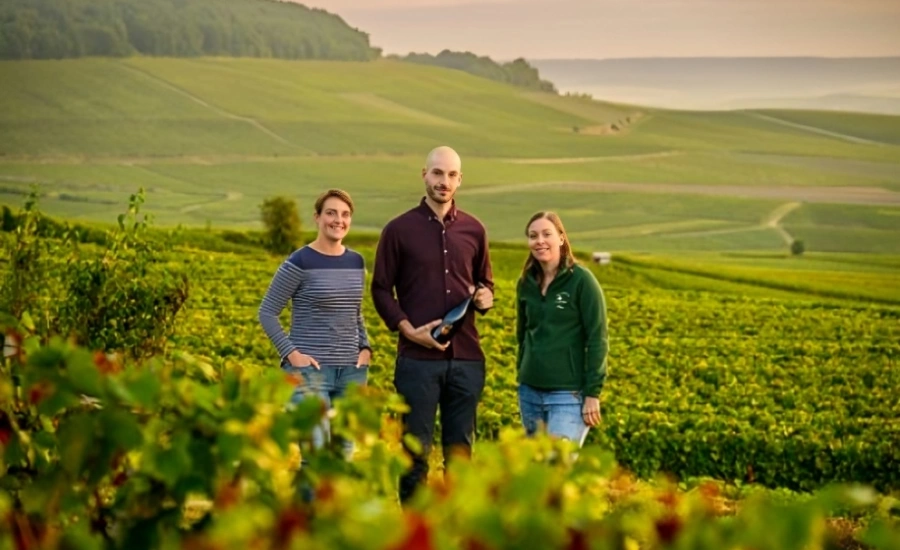 Credit: The De Sousa family ©Leif Carlsson
“Social media has made communication so much easier and communicating is the only way to explain quite complex techniques and also why our prices are higher due to additional costs,” says de Sousa, who uses powerful imagery such as the winery’s four draught horses and sheep grazing in its vineyards. “When people see a ladybird on a vine, it speaks to them.”
Greenwashing vs greenhushing
Whilst de Ville warns that the industry “needs to be very careful about over-claiming,” he has seen no evidence of outright greenwashing. In fact, quite the opposite: “A fear of investigative journalism is causing greenhushing, where people are nervous about putting their head above the parapet for fear of getting shot down. But we also shouldn’t let perfect be the enemy of good.”
De Ville suggests that “being honest about what you’re good at — and not good at — builds trust.” As the industry increasingly pivots towards a more holistic approach to sustainability and methods like regenerative viticulture become potential game-changers, integrity, evidence-based action and meaningful progress are emerging as the primary levers of that trust.
About Sharon Nagel :
British-born Sharon Nagel has been a journalist and translator specialising in wine for 35 years. She writes for leading French online publication Vitisphere and also contributes to corporate communications.