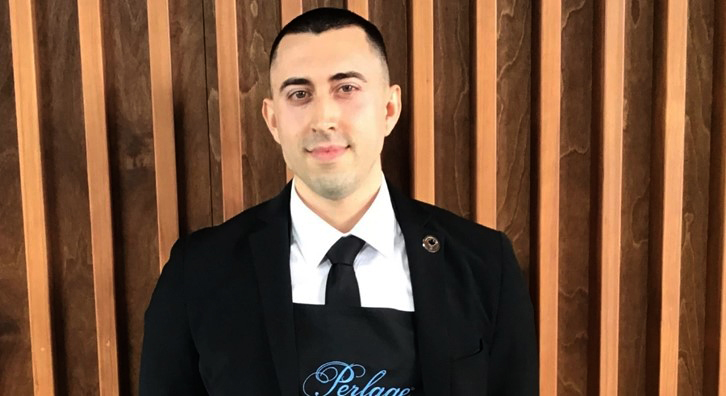

The small Baltic nation might seem like an unlikely home for the world’s best sommelier, but then you haven’t met Raimonds Tomsons.
It seems ironic considering his word-perfect English today that Raimonds Tomsons’ life as a sommelier began with a missed linguistic opportunity: “After secondary school, my plan was to study foreign languages, but it didn’t work out.” Instead, he found himself in a professional school training as a waiter and bartender. A detour that, with time, would prove to be a destiny.
Rather than speak of “eureka moments,” Raimonds prefers to credit the two figures who shaped his sommelier journey, which began in 2000 when he walked into Vincent’s restaurant. It was there, in the Baltic’s first fine-dining restaurant, that he fell in love with hospitality — and then with wine — when meeting the restaurant’s inaugural sommelier “whose passion definitely inspired me.”
Soon after, he came under the wing of chef Martins Ritins — a towering personality in the Latvian gastronomy scene who became far more than a mentor: “He was like my second father, a perfectionist who taught me the right work and life ethics. He encouraged me to study and take part in competitions.”
Ritins also opened doors, sending Tomsons to Noma and facilitating visits to leading European restaurants at a time when the Latvian wine scene was still nascent.
From Lindeman’s to Château d’Yquem
Most of us like to imagine that our first encounter with wine involved an exclusive Bordeaux or Champagne. The truth is usually far less glamorous. Latvia at the turn of the century certainly didn’t offer such a prestigious rite of passage. “The market was dominated by big brands and a handful of revered French and Italian wines. One of the first wines I tried was Lindeman’s 65 Chardonnay. I remember wondering how wine could taste of pineapple, butter and vanilla!”
With his curiosity piqued, competitions entered his life almost organically, starting with national contests in 2005. The Best Sommelier of Europe competition followed in 2008 in Bulgaria, bringing his first “cold shower” — the realisation that improvisation was not an option. The real turning point, however, came in Santiago de Chile at the 2010 Best Sommelier of the World competition. “Watching the late Gérard Basset winning the final so gracefully and elegantly was the moment I thought it could be within my reach.”
What followed was a 13-year ascent marked by near-monastic discipline, and the unwavering support of his family. He developed his plan meticulously with a long-term vision, then built his life around it. With a family, a demanding role as sommelier and little leisure time, the only quiet hours were before dawn. “Imagine waking up during winter when it’s cold, damp and dark outside and everyone is sleeping. You ask yourself — is this going to work and why am I doing this? You have to overcome that.” The first results soon eased his doubts: “When you see yourself shaping up as a sommelier and your knowledge and confidence are growing, it’s like the pump you experience after a good session at the gym!”
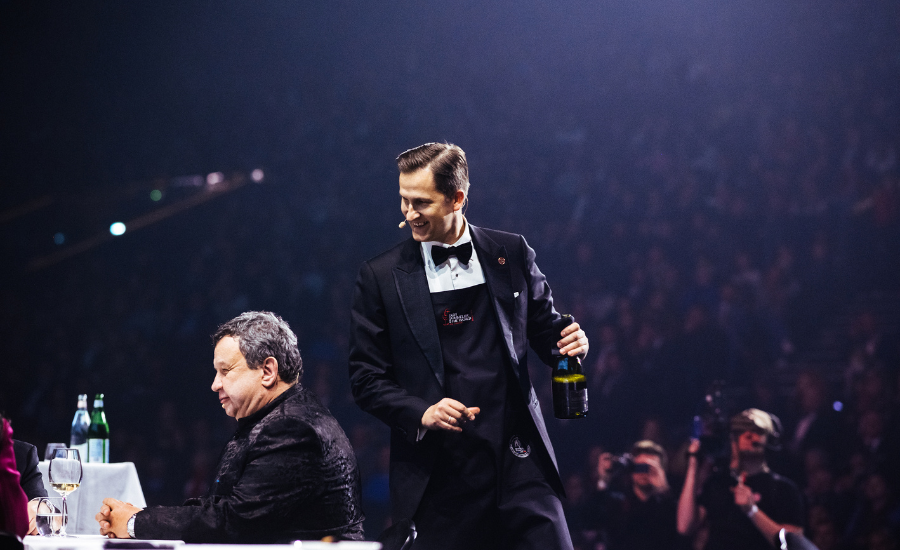
Those feelings only intensified as he finished seventh in Mendoza in 2016, then third in Antwerp in 2019. The build-up to the 2023 championship in Paris reflects his single-minded determination and ability to combine knowledge with physical and mental conditioning — prerequisites, he says, for winning. When the ultimate accolade finally crowned his years of dedication, his first emotion was unexpectedly one of relief: “In a positive way. Imagine accomplishing one of the most important goals in your professional life. I wish everyone could experience what I felt.”
Mentee to mentor
Reaching the pinnacle of one’s career opens vast opportunities — and often a shift in perspective. “My viewpoint as a sommelier hasn’t changed. What has changed are the opportunities you’re given after winning, and the challenge of choosing those you accept and those you kindly refuse.”
The title also brings expectations: “I feel it’s a huge responsibility. People see you as an ambassador, an inspiration, an example.” Equally important, he adds, is “keeping your feet firmly on the ground and trying not to lose the essence of being a sommelier,” especially as he now sees his role as mentoring and inspiring “young ambitious sommeliers who take you as an example. It’s important to give back to the industry.”
After Paris, Raimonds’ life did indeed change. He stepped into the role of wine buyer at Barents Wine Collectors in Riga, and chose to give more time back to his family. “I miss the dining floor sometimes — seeing guests leave happy is a great feeling — but working with importers and distributors is so interesting and dynamic. And I get to spend evenings with my family.”
The new role offers other rewards too: “You can educate yourself without the pressure of competition. You can speak with growers and sometimes learn things you would never learn in a book, and then bring those stories back to your colleagues.”
Human connection and life experience also shape Raimonds’ approach to hospitality. “Beyond all the knowledge, what makes a great sommelier is understanding each client — and that can take different forms. You need to be humble, try to understand what your guests are telling you and leave your ego at home every time you put on your sommelier attire.”
In an industry where consumers often feel intimidated, not only by the language of wine but also its rituals, Raimonds’ philosophy is refreshingly approachable. “People with simple wine knowledge need simple explanations. The art of a great sommelier is to compare what’s in the glass with things from real life that make sense to that particular person. Sometimes wine terminology has to go out the window.”
Credit: Raimonds Tomsons
Dismissing dogma
His approach to food and wine pairing follows the same logic: “I think it’s overcomplicated. Yes, there are certain guidelines and laws — elements in food and wine do react with each other. Is there such a thing as a perfect pairing? Yes and no. Ultimately it’s very subjective, and personally I’ve always followed my feelings.” White Burgundy with steak in a peppercorn sauce? “Will it be a perfect match? Probably not, but who cares?”
He may be dismissive of dogma, yet his respect for “truly magical” food and wine moments is tangible. Guided more by intuition and open-mindedness, some of his most memorable combinations defy textbook logic: Château d’Yquem with honey-glazed suckling pig at Osteria Francescana, or wagyu carpaccio with yuzu ponzu sauce, wasabi and lime paired with single-vineyard Marlborough Sauvignon blanc at Vincent’s. “When pairing, you need to stay open-minded and break some of the stereotypes — you’ll have a much better experience.”
The wines currently stocked in his fridge mirror his curiosity: underrated corners of Southern Italy; modern wines from Spain that debunk the myth of excessive alcohol and extraction; Chenin blanc and Muscadet from the Loire; Languedoc and Greece.
One category, however, is unlikely to appear there: low-alcohol or non-alcoholic. “Maybe I’m wrong and the techniques will improve and we’ll experience something where price and quality align. But at the moment, I don’t feel they deliver pleasure for the money.” He also questions another prevailing trend, hoping the more extreme aspects of premiumisation will ease: “What really concerns me is that the wine world is becoming more inaccessible to the majority of wine lovers. I really hope that at some point the bubble will burst.”
As for his future plans, they are likely to remain under wraps: “I prefer to share them when I’ve accomplished them rather than on social media. For me, you have your ambitions, your goals, your plan and you work hard. Trust me, the world will find out, respect you for it and congratulate you when the right moment comes.”
Credit: Raimonds Tomsons
About Sharon Nagel
British-born Sharon Nagel has been a journalist and translator specialising in wine for 35 years. She writes for leading French online publication Vitisphere and also contributes to corporate communications.