
Author: World Bulk Wine Exhibition
As wineries across the globe groan under the weight of unsold inventory, distributors and retailers are capitalising on current market conditions to offer premium wines at once-unthinkable prices.
Call them what you will – own label, private label or control label – exclusive brands are making hay while the sun shines over premium wine regions that once commanded, well, a premium. According to the 2026 BMO Wine Market Report, more than 30% of all wineries in the US are looking to offload estate wine through bulk channels while 11% are holding bottled but unlabelled stock. From Napa Cabernet to reserve-grade Australian Chardonnay and barrel-matured Bordeaux, top-flight names are increasingly finding their way into private labels – a shift that is changing perceptions of bulk wine, reshaping producer-retailer relationships, and potentially recruiting new consumers into the category. In many cases, private label is no longer competing with entry-level wine, but with established premium brands themselves.
From inventory management to operational efficiency
“There is greater emphasis on attempting to do a control or private label than there ever has been before”, observes Steve Fredricks, president of Turrentine Brokerage, California’s largest independent wine brokerage. “Because everybody’s margin has been squeezed for so long”. Although Fredricks notes some reluctance among established wineries to enter the private label space – fearing it might cannibalise sales of their national brands – he agrees that many increasingly view it as another route for moving excess inventory.
In New York, Rabobank beverage analyst Bourcard Nesin notes that “private label has become a growing part of revenue for lots and lots of firms. It used to be the purview of specialised players, but a lot of brands with excess inventory are turning to private label, not to make money, but to improve efficiency of their operations”.
Nick Whiteway, whose South Australian company First Growth Premium Wine Sales specialises in private label programmes, tells a similar story from the other side of the globe: “Every winery in Australia is sitting on unsold stock right now. Some wineries have stock going back six or seven years, and it’s burning a hole in their balance sheet”.
On the retail side of the equation, the motivations are equally clear-cut. “With a private label, buyers control the brand, the price and their margin and that’s why they want them because it’s a highly competitive marketplace”, says Whiteway. “Both online and physical retailers need control of the brand because otherwise they’re taking on too much of the financial risk”. Whiteway also sees the growth of online wine sales as a major catalyst for retailer interest in exclusive labels. “Everything on the internet is transparent. If I sell a premium packaged wine under a pre-existing brand to buyer A and they sell it online at a discounted price, I can’t sell that label to any other buyer. Invariably, if buyer B wants wine from the same winery, they need a different label. That’s where all this is coming from”.
From a consumer perspective, the proposition is equally compelling. According to Mintel data, acceptance of own-label alcohol is high in certain markets, with 58% of UK alcohol buyers agreeing that supermarket own-label products are “just as good” as branded alternatives. In the US, “retailers doing programmes like Kirkland or Trader Joe’s are sourcing from very good sources, comparable to those for some of the other varietals, but at a better priced advantage”, says Bryan Foster, national sales manager of strategic brands at Turrentine Brokerage. The quality of wines entering private label programmes has shifted dramatically, with oversupply blurring the traditional boundaries between bulk/private label and national brands. Crucially, the wines entering these programmes are no longer confined to anonymous entry-level blends. “Buyers don’t want to just sell some cheap slop that no-one’s ever heard of because they can’t convert that to the consumer”, says Whiteway. “They want wines that have brand equity in the marketplace that consumers have heard of. There’s a latent demand in the market from consumers who have familiarity with some of these historical legacy brands”
See also: The great rebalancing act: the Southern Hemisphere 2026 vintage takes shape
Delivering what consumers want – not the critics
Private labels also provide greater control over the product profile itself, delivering styles that practitioners feel are more closely aligned with consumer tastes. The model is one where repeat purchases matter more than critical acclaim. “Going down an esoteric rabbit hole, a lot of wineries are making wine to keep the critics and journalists happy”, feels Whiteway.
“The classic one in Australia is no oak, high acid, fresh and all this contemporary stuff. That’s not what the consumer wants. When they spend $25 to $30 on a bottle of South Australian Shiraz, they want rich, smooth and they want to be smacked on the head with a piece of wood! We’re making wine for the consumer, and being very successful commercially. We’re giving the market what it wants. Isn’t that what’s wrong with the wine industry?”
This, in turn, is creating what Whiteway describes as a “symbiotic relationship” between producers and retailers, supporting not only inventory management but also new opportunities through range extensions and broader channel distribution. What private label may lack in margin, it can make up for in volume throughput, economies of scale and predictability, says Whiteway whose company currently operates in the domestic market but is looking to expand overseas. “Do you want to bottle your wine speculatively under 27 different labels, put it in your shed, hope that you might sell some, pay a warehousing fee and maybe sell it, maybe not? Or do you want to bottle thousands of cases in a single order – receive the purchase order, bottle the wine to order, ship it out the door and get paid in 15 to 90 days?”
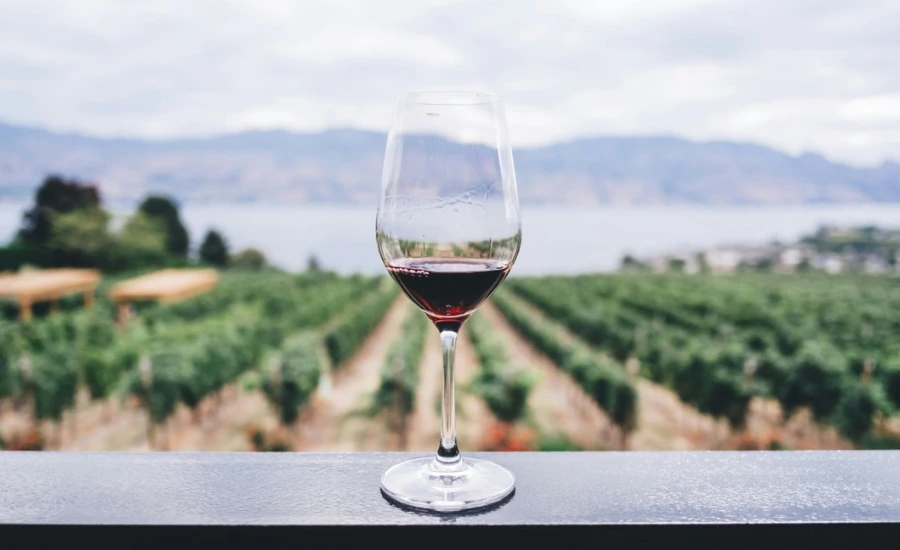 Credit: glass of wine in front of a vineyard
Narrower bandwidth
The pragmatic commercial realities shaping the private label market leave little room for discovery and experimentation. Familiarity and scalability matter more than regional exploration. “The private or control label system is very traditional”, says Bryan Foster at Turrentine Brokerage. “Retailers can’t just put this variety or region on the end stack unless it’s being sold by price and really create anything. They want to put something on the shelf that will sell itself. And consumers don’t want to spend X dollars on discovering something they’re not familiar with”.
Nick Whiteway agrees: “Buyers are purchasing the standards – Shiraz, Cabernet-Sauvignon, Chardonnay, Pinot Noir, Sauvignon Blanc, Pinot Grigio and sparkling, that’s it. They’re not buying Tempranillo, Nero d’Avola or Sangiovese because these varietals don’t turn over enough volume to justify a large purchase or bottling run”.
Consolidation across the retail and distribution landscape is similarly narrowing the bandwidth: “Retailers and distributors have so much inventory, so many SKUs and there’s only so much shelf space”, says Fredricks. “And if you want to go directly to the consumer, that’s expensive and it’s a long-term investment – the finances simply aren’t there for it”.
Finance and cash flow pressures have unquestionably fuelled the rise of premium private labels but opinions remain divided over just how sustainable the model will prove in the longer term. Indeed, the very conditions stoking the boom also raise questions about its long-term sustainability. “I think the category will continue for the foreseeable future until inventory drops”, says Fredricks. “Will there be more $20 to $30 private or control brand product in the market three to five years from now than there was before? Yes, there will be, because the land values will have decreased, grape prices will have decreased so those products at those price points can be developed for a longer period of time and more profitably by people”.
Bourcard Nesin at Rabobank takes a more cautious view: “Every single product category is in a state of massive excess supply. And the retailers can take advantage of it for now, but those programmes aren’t going to be sustainable. So having a long-term plan that includes the end of the low-cost fruit, low-cost wine era is necessary. I think a lot of firms will ignore that and make huge commitments and eventually face a very difficult time when the underlying economic and industry trends change”.
The rise of the asset-light model
In Australia, former economist Nick Whiteway sees another dynamic beginning to take shape: “The fundamental economic demand drivers aren’t changing, it’s just that somebody else owns the assets”, he says, pointing to Endeavour Group’s announcement in May that it would reduce its own grape production by more than 80% with approximately 99% of sourcing to come from purchased grapes and bulk wine.
A similar asset-light model is emerging in California: “National companies are somewhat resistant to put their foot in the water but negociants have really materialised here in the US” notes Bryan Foster. “They’re not bricks and mortar wineries but they appease the retailers’ request for private or control label programmes”.
For Whiteway, the rise of private label – including its increasingly premium iterations – are not just reflective of the oversupply. It also speaks to the growing need for both online and bricks-and-mortar retailers to control brands, pricing and margins. The private-label boom may have been accelerated by oversupply, but the underlying shift in retailer power and route-to-market dynamics appears far more permanent.
On the production side, private label may be viewed as a necessary evil, or conversely, as a stepping stone towards closer retailer relations and broader brand development opportunities. “I think private label was a dirty word in the industry, but I’ve got a whole bunch of wineries that wouldn’t be here today if it weren’t for the private label business we’re doing. If you stop supplying private labels there isn’t another magic channel that’s big enough to absorb your volume. This business is here stay”.