
In a market defined by rising costs, Aldi’s shelves tell a different story. Between back-to-back tastings, Roger Anthony, the retailer’s senior BWS buyer in France, reveals with disarming clarity the tactics that keep its bottles budget-friendly.
Aldi France’s wine department has made headlines over the past few months, and it’s not for a shiny new label or tasty new blend. With tensions running high in the country’s wine industry, the discounter has come under fire for its pricing policy. Yet Roger Anthony, the retailer’s senior BWS buyer in France, brushes off the controversy as he reasserts the retailer’s longstanding focus on delivering value.
“Our prices aren’t the lowest – other retailers do that – but we prioritise value for money,” he said.
Aldi prides itself on keeping wine affordable even in the face of inflationary pressure. During its annual autumn in-store wine festival in September, 53% of the wines retailed for under €4.59, a price point that many feel is not viable for producers. Anthony explains how the discounter’s disciplined sourcing and logistics efficiency allows it to retail good wine for as little as €1.99 a bottle.
One of the most striking aspects of Aldi’s wine department – a trait shared by other discounters – is its extreme rationalisation. The permanent range features just 70 SKUs marketed across its 1,350 stores nationwide, with an additional 15 or so tailored to regional tastes. “For example, in Alsace, our national range features a Riesling and a Gewurztraminer but we add a Sylvaner, a Pinot Gris and a Pinot Noir to the regional selection to align with local consumption trends.”
These are the only “frills” the retailer allows itself: “Take Bordeaux. We’ll have an entry-level Bordeaux, a chateau and one Médoc, whereas other retailers may carry ten different Médocs.” Such tight curation delivers economies of scale, but it also puts pressure on the sourcing to be flawless. “Across its different departments, Aldi only markets 1,800 products compared with 20,000 or 25,000 in other retail stores so we can’t make any mistakes,” notes Anthony.
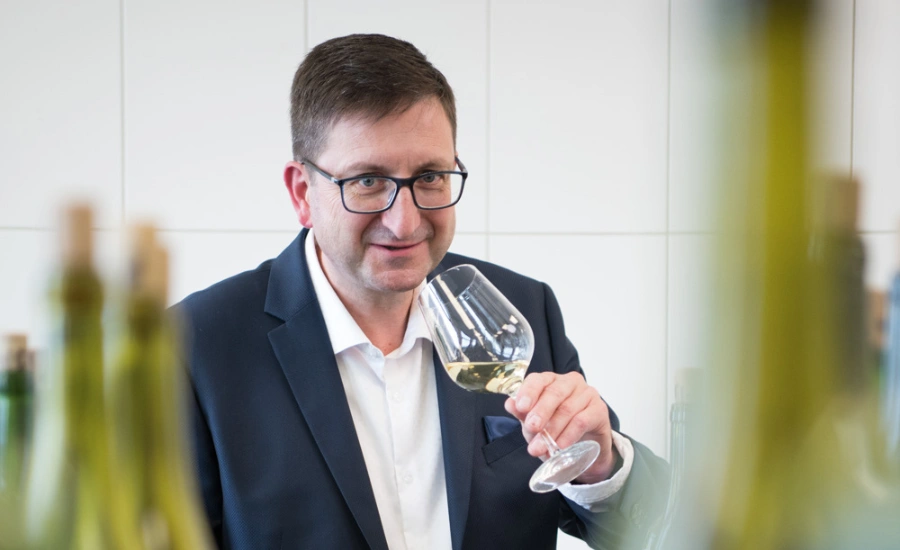 Photo : RogerAnthony (c) Aldi France
Rigorous funnel
As a result, the selection process is wide at entry and narrow at exit. Over 6,000 tastings are conducted, but just five to 10 wines earn a place on Aldi shelves every year. Neither will you find any national wine brands in Aldi France stores. “All of our wines are sold under our own brands. This is our policy across the store, for 90% of our products but 100% of our wines – though admittedly, there are virtually no true national wine brands.”
Over time, Aldi has honed a rigorous system for developing its own brands, giving it tighter control over costs and sourcing. “I designed the Jean Giner brand 12 years ago,” explains Anthony. “The first SKU was a Chardonnay because at the time Burgundy prices had rocketed and I wanted a nicely presented, oaked Chardonnay in a Burgundy-style bottle.”
The award-winning Pays d’Oc-labelled wines now include a Cabernet-Sauvignon that retail for between €2.49 and €2.69. A year ago, Aldi introduced a three-year contract for the range: “We agree to buy the wines for three years from the same supplier, which has been with us since the start. It means that they can plan ahead and we can secure consistent quality. Our Jean Giner supplier was able to invest in facilities and bottling equipment, for Aldi and other customers.”
I could launch a tender, buy the cheapest wine and make suppliers toe the line. I might benefit for the first year, but you don’t build anything over the long term that way.
While Jean Giner is the only wine covered by this specific contract, Anthony emphasises the value of long-term supplier relations more broadly: “Our other contracts cover at least one year and set terms for both volumes and durations. Some of our suppliers have been with us for 25 to 30 years. Obviously, I could launch a tender, buy the cheapest wine and make suppliers toe the line. I might benefit for the first year, but you don’t build anything over the long term that way.” Anthony should know – he not only selects the wines, but also negotiates the contracts from the company’s HQ in France.
Strict quality control
Anthony and his team, who only purchase pre-packaged wines and never in bulk, also oversee the quality control process. “We have specialised laboratories for our wines that test them on arrival so that we have a control sample. Around 2,300 analyses are conducted every year. The wines are regularly tested and tasted to ensure the quality remains consistent throughout. You can have the best wine ever, but if a supplier fails to maintain his standards, we see it immediately.”
Wines submitted for tenders are blind tasted and the team also benchmarks its wines against competitors while exploring new offerings such as alcohol-free wines. So far, Anthony remains unconvinced: “Personally, I think they work on the nose but they lack length on the palate, and that is an issue for me. There is obviously a trend for alcohol-free wines, but I think we’ll test them first on an occasional basis and see how our customers react.”
Market intelligence clearly guides Aldi’s wine selection. Last year, Anthony launched a range of wines specifically targeting a younger audience and is very satisfied with the results, albeit with a few caveats. “The range is labelled Vin De France and is nicely presented with six different labels per colour. The rosé and the white are very successful, but we are struggling more with the red.”
Feedback from young consumers have prompted tweaks: “They wanted slightly sweeter styles, so we have shifted to AOP Rosé de Loire and to Côtes de Gascogne for the whites which are also sweeter and fruitier. Young people don’t want the kind of mature, tannic wines I grew up with. They want easier-drinking, fresh, fruity wines.”
Aldi France also plans to focus on boxed wines, which account for around 40% of sales in French supermarkets across-the-board, and to extend the Jean Giner range with some premium labels for the festive season. “But there won’t be any revolutions at Aldi. We move forward one step at a time. Our core range is fairly stable. We adjust it every year based on new market opportunities, gaps in the range and shifting demand.”
Optimising efficiency
After 33 years with Aldi France, Anthony embodies the kind of stability he seeks in his wine range, leveraging a number of techniques to optimise efficiency. “We capitalise on every opportunity to ensure economies of scale. With the packaging, for example, we cut through the blurb to keep it simple.”
Logistics are another key area of the supply chain for savings. “A lorry never leaves half full, and all our pallets are fully loaded. We constantly maximise the potential for cutting costs.” While large consignments are central to Aldi’s cost strategy, they are not necessarily of the magnitude you might expect. “Our rationale size-wise is always a pallet and not minimum volumes,” explains Anthony. “Depending on the palletisation plan, that means either 100 or 130 boxes. Aldi’s strength is to be proactive and order large shipments, but we can order smaller amounts for one-off promotions or our in-store wine festival.”
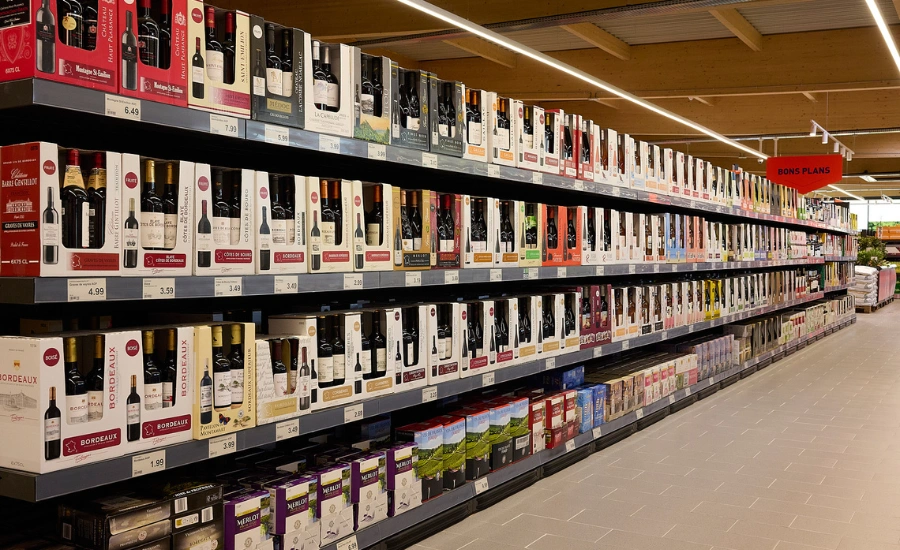 Photo : Aldi France wine department (c) Aldi France
Importantly, he adds, “we do not exclude any supplier – they can range from small winegrowers to large co-operatives. There is a place at Aldi for everyone”.
Anthony offers some context for the company’s sacrosanct criterion: “Value for money is in our DNA. Aldi was established in Germany in 1948 and has operated in France for 35 years, but its policy has remained unchanged. We are proud to champion this model and will remain discounters. Today, you see Porsches and Mercedes in Aldi car parks. Everyone knows how to count.”
Although the war in Ukraine disrupted some of the retailer’s buying processes, Anthony notes that his team’s agility enabled it to sidestep many issues faced by other chains. “Like everyone else, we experienced an increase in prices at the start of the Ukraine war. All the entry-level bottles were produced in Ukraine and the cost of dry goods surged. When we ran out of transparent bottles, we switched to bag-in-boxes so that our customers continued to have ‘their’ wines.”
At Aldi France, wine is considered a crucial consumer category. “Prestige is perhaps a bit strong, but we focus on providing a coherent range with nice packaging and properly defined brands. Wine is synonymous with joyful occasions and even though consumption is declining and young people are drinking less, wine for me is still a great product that we need to look after. We also need to listen to consumers so that it can adapt to shifting trends.”
About Sharon Nagel:
British-born Sharon Nagel has been a journalist and translator specialising in wine for 35 years. She writes for leading French online publication Vitisphere and also contributes to corporate communications.