
Author: World Bulk Wine Exhibition
As harvesting wraps up across the Southern Hemisphere’s key wine producing regions, a clearer picture is emerging of both quality potential and volume expectations. The vintage is also shedding light on the challenges facing bulk wine marketers navigating a market still marked by cautious demand and structural imbalance.
“It feels as though the wine industry – much like many consumers globally – is on its own course of Ozempic or similar GLP-1 medicines. We’re shedding volumes, though of a different kind, as we attempt to correct years of a build-up that’s left us a little out of shape”, said Wine Marlborough’s general manager Marcus Pickens in the latest issue of Winepress. He added: “The imbalance is obvious, and there’s a shared understanding that we must return to equilibrium as quickly as possible”. Although his comments refer specifically to the New Zealand wine sector, they resonate far more broadly, reflecting vintage strategies adopted across many Southern Hemisphere producer countries. This ‘right-sizing’ of the Southern Hemisphere crop suggests a strategic shift away from the volume-driven dynamics of the last decade as producers prioritise inventory health in the absence of increased market shares.
Unprecedented challenges in Australia
That rebalancing is also evident across the Tasman Sea. Although official estimates have yet to be released, a March report from the Australian Bureau of Agricultural and Resource Economics and Sciences (ABARES) forecast a 20% decline in Australia’s 2026 crop, estimating the harvest at around 1.25 million tonnes. This figure sits significantly below the ten-year average of approximately 1.7 million tonnes, signalling a painful but necessary correction to the oversupply issues that have plagued the sector’s commercial viability in recent years. The report points to rising input, water and fuel costs combined with falling grape prices as key pressures shaping production decisions this season. Speaking to local media, Lee McLean, chief executive of Australia Grape and Wine, said: “Grape growers and winemakers are facing the most challenging set of commercial conditions they have ever faced in Australia”.
While volumes are down, many producers are reporting strong quality potential for the Australian vintage. “2026 is an outstanding vintage that provides an interesting contrast to 2025… Vineyard canopies were well balanced heading into Christmas, driven by strong soil moisture at budburst, followed by a dry December”, comments Nigel Westblade, chief winemaker at Peter Lehmann Wines which sources fruit from across the sub-regions of the Barossa Valley. “A series of heat events, combined with minimal rainfall through January and February, kept the vines working hard. In early March, several tropical systems tracked south, delivering welcome rainfall that refreshed the canopies and supported them through to the end of the season. The extended ripening period, together with lower crop levels, has enabled full tannin ripeness to be achieved at relatively modest sugar levels. Tannin structure is notably more refined this year, with a few exceptions, providing winemakers with excellent blending opportunities once allocation begins”.
More crop capping in New Zealand
Neighbouring New Zealand is also describing the 2026 vintage as “stunning”. Drew Ellis, chief winemaker at the Marlborough Grape Growers Cooperative (MGGC), reported that “dense, rich flavours in the vineyard have carried through into ferment, giving bright Sauvignon character with plenty of depth and weight”. From a volume perspective, the cooperative’s CEO Mike Brown said its harvest is down 38% year on year: “Most vineyards were set to yield at cap – 13.5 tonnes/hectare, a good ratio for flavour concentration and achieving optimal ripeness”. The majority of MGGC’s production is allocated to its multi-year customers and the cooperative has continued to expand its branded presence with ranges such as Marlborough Heartland recently securing listings in Norway and Singapore. “The other significant wine project for us is the Art of the Growers Marlborough Sauvignon bag-in-box project we have in Sweden, which has been selling very well after the launch in Systembolaget back in December”, Brown added. New Zealand Winegrowers is expected to release the first in a series of national production updates later this month.
New market inroads for Argentina
In Argentina, the Instituto Nacional de Vitivinicultura (INV) has already issued its production estimate, showing a 10-12% decline on last year’s 10.7 million hectolitres, though with differing outcomes for the two leading producer provinces. While Mendoza is expecting a 15% drop, San Juan is forecast to see production rise by 10%. “Vineyards enjoyed better conditions than in 2024 and 2025”, explains Juan Manuel Palomo, manager of the Argentine Bulk Wine Chamber. “It was not so hot in January and February and this promoted better conditions for colour and sugar, potentially allowing us to have lower alcohol wines. We are expecting a great vintage, similar to 2021 or 2015”.
Strong quality expectations combined with improved availability and a significant drop in prices this year – ranging from 20 to 30% – are fuelling hopes of renewed international market momentum among Argentine bulk suppliers, particularly as the country prepares to host Vinexpo Explorer Mendoza 2026 from June 8-10. “The local market used to consume 75 to 80% of Argentine wines annually – now that has dropped to around 50%”, explains industry veteran José Bartolucci, president of the Argentine Bulk Wine Chamber. “We now have more stock, better prices and availabilities of naturally organic wines that align with global demand for sustainability”. The pivot is a timely move as many leading buyers tighten their ESG requirements.
First quarter export figures confirm that Argentina is making renewed inroads into the global bulk wine market, although the Argentine Bulk Wine Chamber cautions that the headline growth rates should be viewed in context.
“In 2020, we used to export up to 100 million litres of generic wine. In 2025, we exported just 5-7 million litres, which is why there were big increases”, explains Palomo. Bulk shipments nevertheless remained the main drivers of overall export growth, rising 54.6% year-on-year in the first quarter and lifting bulk’s share to 34% of total exports compared with 25% in previous years. “Argentina only represents 1.5% of global bulk wine exports, compared with say 9-10% for Chile or 10-15% for other competitors”, adds Bartolucci, while forecasting strong opportunities for Argentine suppliers this year. “Argentina has improved its competitiveness compared with other Southern Hemisphere suppliers, particularly for generic segments, notably whites: we are combining the quality of the 2026 vintage with competitive pricing and the ability to supply at scale”.
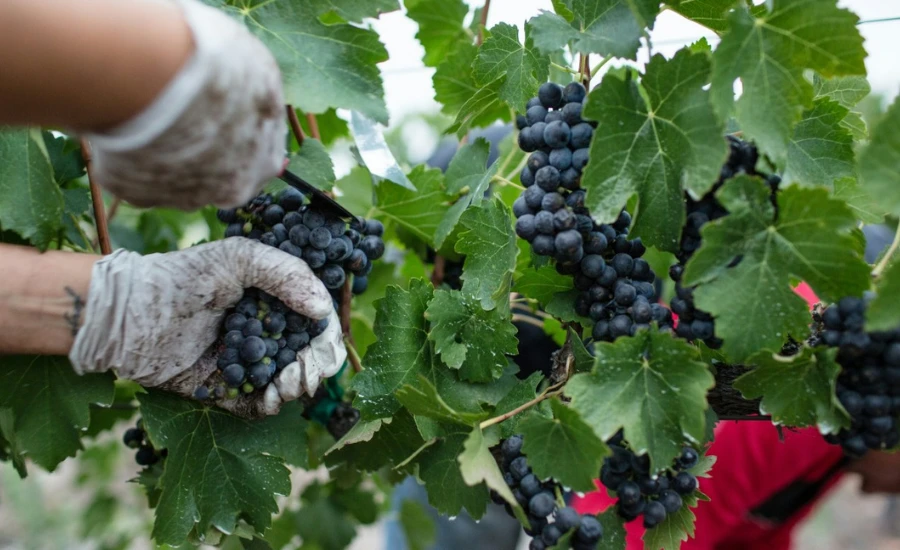 Credit: a person who is doing grape harvest
Higher prices in Chile
In neighbouring Chile, suppliers are unlikely to match many producer countries on pricing this year. Citing a disconnect between growers’ expectations and the commercial realities faced by many wineries, Marco Adam of Ciatti points to elevated grape prices as a key constraint on export competitiveness. “We’re now competing again with South Africa – where suppliers hadn’t been competing with us for three years – and we have no chance of competing with Australia or even New Zealand. With expensive grapes, we will not be able to match prices in any of these three countries”. Significant vineyard uprootings in recent years – estimated by Adam at between 25 and 30% of total acreage – coupled with more positive sales trends at the time grape prices were set have nevertheless raised growers’ expectations. “It’s good for growers, who have finally seen some relief after five difficult years of selling their grapes at very low prices, and stocks at the end of December were also lower than expected. But globally, sales remain challenging: they are slower than normal everywhere, and Chile seems to be less fashionable than it was 10 or 15 years ago”. The dilemma for Chile in 2026 is one of positioning: Chilean suppliers find themselves caught between rising domestic production costs and a global bulk market that has yet to fully embrace Chile’s move toward premiumisation.
In volume terms, however, prospects appear more positive. Following a favourable summer, with good water availability for irrigation, crop expectations have been revised upwards. “In our last report, I said 850 million litres, but today I would probably say between 900 and 950 million, but still below 1 billion litres”, says Adam. Although “horrendous rain” affected picking in mid-March, the early pace of harvest meant that a large proportion of fruit was already safely in wineries. “Apart from a couple of small wineries, everyone handled the situation very well”. While the short-term outlook remains challenging, Adam is more optimistic about the longer term: “I don’t think the decrease in consumption will continue”.
Good quality and quantity in South Africa
The coming year, however, is expected to be anything but plain sailing. “2026 is going to be tough on wine sales, pricing and movement especially”, confirms Magnus Kriel, winemaker and general manager at Merwida in the Breede River Valley, South Africa. After enjoying something of a respite in 2024 and 2025, which saw a slowdown in vine pulls and implementation of new planting programmes, the South African wine industry is once again under strain. “We had quite a good 2025 vintage and the market was good. But then towards the end of 2025, everything came under pressure overnight. The wine is still moving, but it’s slower”.
With harvesting at Merwida spanning a total 12 weeks, the new vintage is almost ready to enter the market. “I’m very happy with the quality and quantity, but we’re all under pressure. There’s going to be a drop in price – if there’s too much supply and little demand then prices need to come down so that we will do. Then hopefully shelf prices will follow and we can get wine moving again and bring the market back into balance. That’s the whole issue – there are still too many grapes”. Although Kriel believes “it will take more than a year to recover equilibrium between sales, marketing and production”, Merwida’s focus remains firmly on the future.
New plantings – dominated by Pinot Grigio, Sauvignon and Chardonnay – began coming on stream this year, taking the winery’s vineyard holdings up to nearly 1,000 hectares, and aligning the varietal range with the most in-demand styles. Nationwide, South Africa Wine forecasts a larger crop this year with “quality indicators showing strong potential across several cultivars”.
Throughout the Southern Hemisphere, the 2026 harvest is shaping up as one of contrasts: generally encouraging quality and, in several countries once again, deliberately reduced production, yet still unfolding against a backdrop of fragile demand and price pressure. As the ‘Ozempic effect’ continues to lean the industry out, for bulk suppliers the year ahead is likely to remain defined less by what is in the vineyards than by how quickly global markets can absorb what is already in tank.